Drone show radio links: keeping command above a crowd of phones
Commanding hundreds of drones above thousands of phones: bands, 868 MHz duty-cycle rules, crowd RF effects, dual-path links and what happens on link loss.

In this article 7 sections
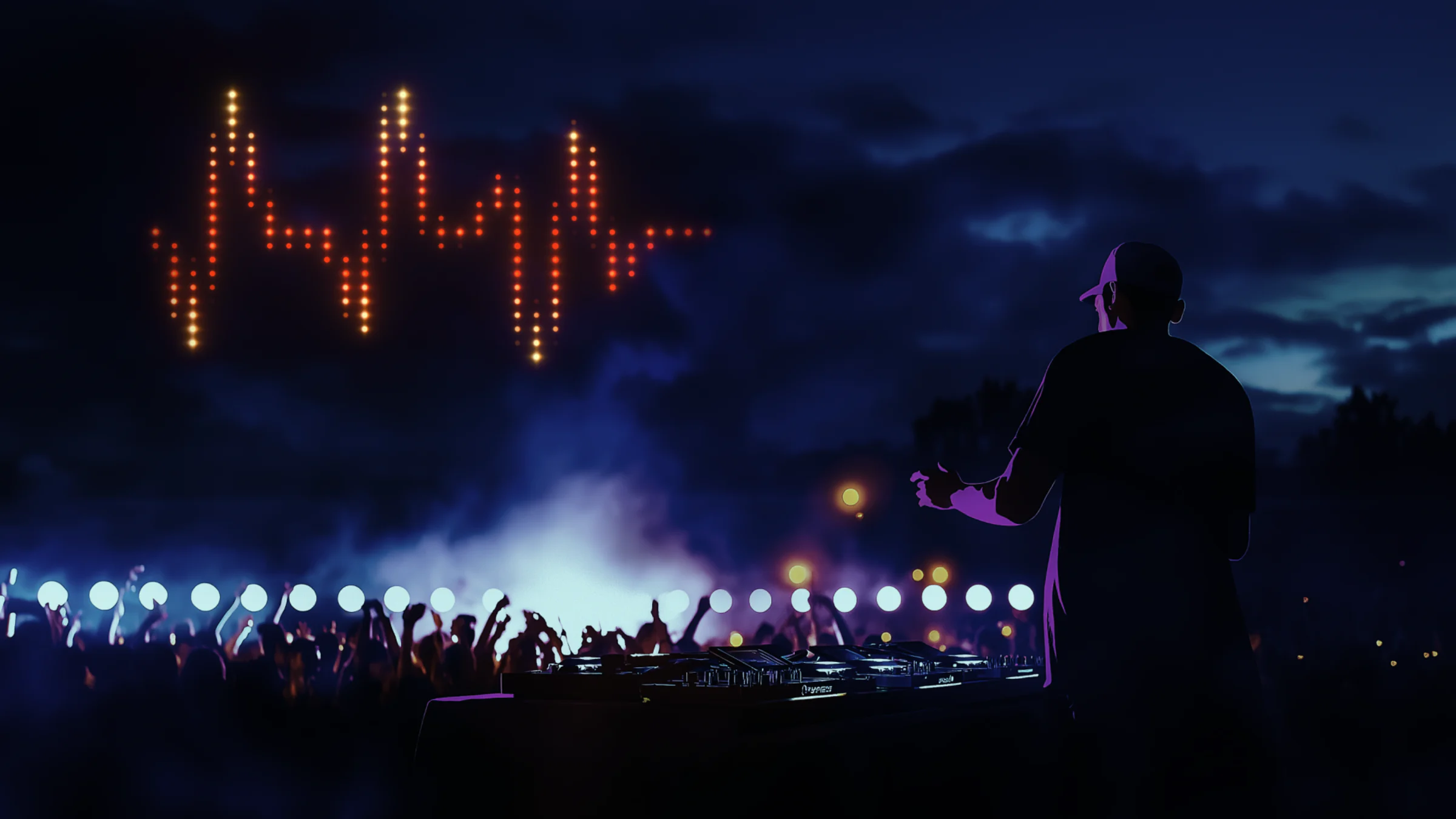
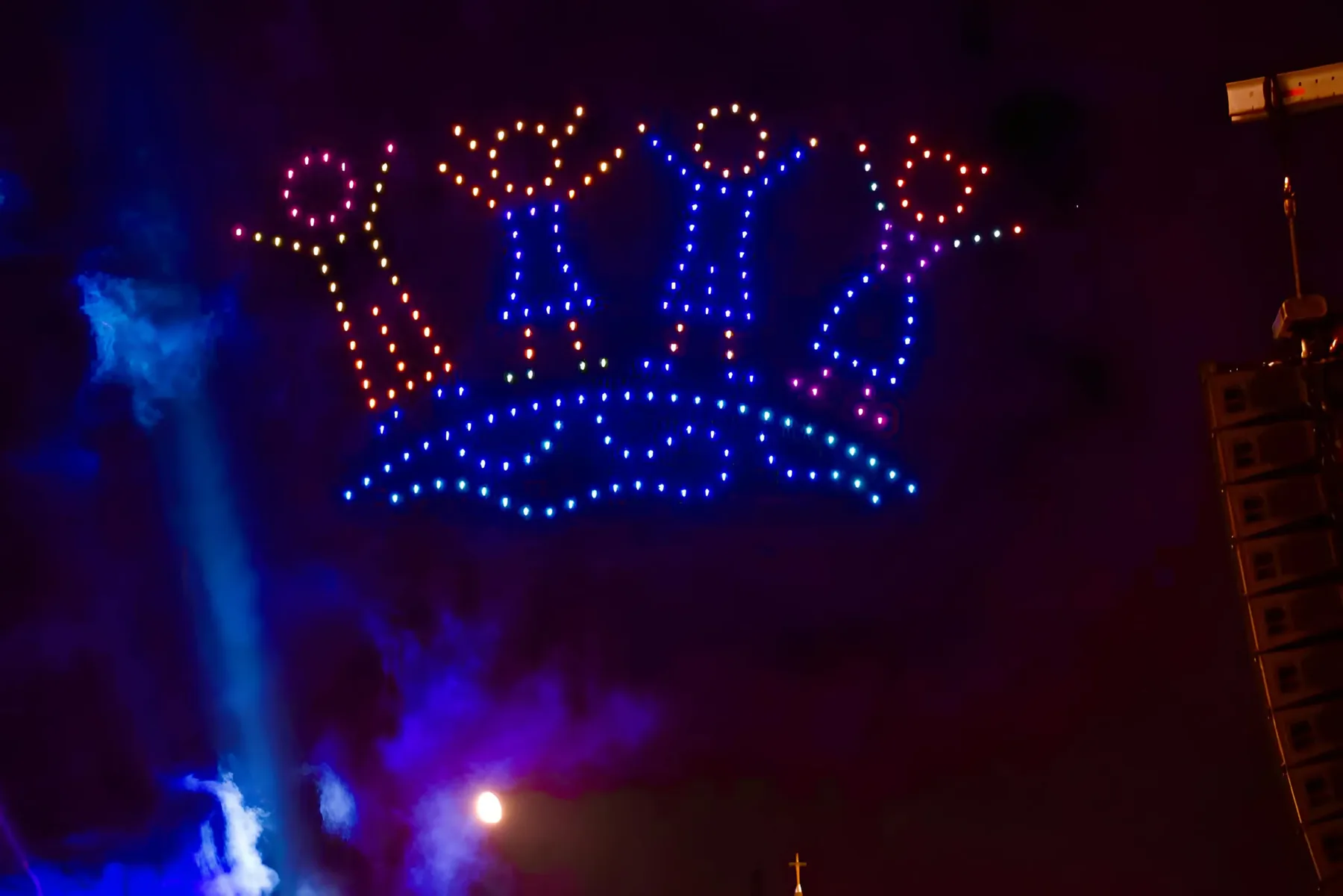
Picture the final minute of a festival drone show. Several hundred aircraft hold a formation above the stage, and below them a crowd that may run to tens of thousands of people holds up phones to film it. Every one of those phones is a radio transmitter. So are the stage wireless microphones, the in-ear monitors, the broadcast links, the security radios and the venue Wi-Fi. Somewhere in that noise, the ground station has to be able to tell every drone to start, to hold, or to stop, and know it was heard.
Radio is one of the least discussed parts of drone show engineering, and one of the most important. This article explains the problem the way we approach it when we design aircraft, write fleet software and plan a site: which bands do what, what a crowd does to them, what has to stay on the link, and what a drone should do when the link goes quiet.
Three bands, three trade-offs
Most drone show links live in licence-exempt spectrum, and in practice that means three neighbourhoods. Each trades capacity against range in a different way.
| Band | Strengths | Weaknesses at a show |
|---|---|---|
| 2.4 GHz | Global, cheap, well understood | Only about 83.5 MHz wide, with three non-overlapping 20 MHz Wi-Fi channels; shared with almost every phone, speaker and headset in the crowd |
| 5 GHz | Far more channels and capacity | Shorter range for the same power, more easily blocked by bodies and structures; parts of the band carry radar-protection and indoor-only rules |
| Sub-GHz (868 MHz in Europe, 915 MHz in the US) | Long range, good penetration, a quieter neighbourhood | Low data rates, and in Europe strict limits on how often you may transmit |
The 2.4 GHz band runs from 2.4 to 2.4835 GHz, and at 20 MHz width only channels 1, 6 and 11 avoid overlapping in most deployments. The 5 GHz range spans several hundred megahertz and offers many more 20 MHz channels, which is why it suits a high-capacity primary link. Sub-GHz radios such as LoRa go the other way: Semtech describes LoRa as letting designers trade data rate for sensitivity, with reception possible up to 20 dB below the thermal noise floor. That makes it a strong candidate for a link that must still work when everything else is struggling, as long as you only need to say a little.
Licence-exempt does not mean rule-free
“Licence-exempt” means you do not need an individual licence, not that you can transmit as you like. In Europe, the reference is CEPT’s ERC Recommendation 70-03 on short range devices, implemented through national rules and the harmonised standard ETSI EN 300 220, which covers non-specific short range devices from 25 MHz to 1,000 MHz. Annex 1 of the recommendation splits the 868 MHz area into sub-bands, each with its own power and duty-cycle limit:
| Sub-band | Max power (e.r.p.) | Spectrum access |
|---|---|---|
| 868.0-868.6 MHz | 25 mW | up to 1% duty cycle, or LBT+AFA |
| 868.7-869.2 MHz | 25 mW | up to 0.1% duty cycle, or LBT+AFA |
| 869.4-869.65 MHz | 500 mW | up to 10% duty cycle, or LBT+AFA |
| 869.7-870.0 MHz | 5 mW / 25 mW | no requirement / up to 1%, or LBT+AFA |
Unless an annex says otherwise, the recommendation measures duty cycle over a continuous one-hour period. So a 1% limit means 36 seconds of transmitting per hour, and 0.1% means 3.6 seconds. The alternative, listen-before-talk with adaptive frequency agility (LBT+AFA), replaces the duty-cycle limit with a duty to check the channel before transmitting and move when it is busy. Either way, a duty-cycled sub-GHz link is suited to short, infrequent, important messages, not to a continuous stream.
Two further points matter for shows. The recommendation notes that CEPT does not address aviation safety and that anyone using short range devices on aircraft should consult the relevant aviation authorities. And rules differ by region: in the US, the 902-928 MHz band is governed by FCC Part 15.247, which allows up to 1 W for frequency-hopping systems that use at least 50 channels. At 5 GHz, the CEPT decision ECC/DEC/(04)08 restricts 5150-5350 MHz mainly to indoor use and allows outdoor use at 5470-5725 MHz with dynamic frequency selection (DFS) and transmit power control, so a radar detection can force a channel change. Operators must check the exact rules with their national spectrum and aviation authorities.
What a crowd does to the spectrum
An empty field on a rehearsal afternoon is a poor guide to show night. Four things change when the audience arrives.
- Phones probe constantly. Smartphones broadcast Wi-Fi probe requests even when already connected, and a 2022 study by Alam, Al-Qurishi and Souissi found they tend to probe more when the screen is on and unlocked. At a show, almost every screen is on. Add personal hotspots and Bluetooth, and 2.4 GHz in particular fills with short bursts from thousands of devices.
- Bodies absorb. Human bodies block microwave links. In indoor measurements at 2.4 GHz, Januszkiewicz (2018) recorded a median path loss increase of about 10 dB with one person in the path and about 15 dB with two. A ground antenna at head height behind a dense crowd faces many more than two.
- LED walls radiate. Audio engineers know video walls as a source of broadband UHF noise, sometimes spanning 100 MHz or more, that raises the noise floor within roughly 40 feet (about 12 metres) of the wall, and some walls also produce loud narrowband spurs.
- Production radio is dense. Large events coordinate a lot of radio. At its 2026 edition, the Montreux Jazz Festival used 156 channels of wireless microphones and 40 channels of in-ear monitoring across ten stages, with professional frequency coordination. Broadcast trucks, intercoms and security radios add to that.
Radio problems at shows are not hypothetical. There have been incidents where a strong radio signal was detected minutes before a performance and the drones could not find their positions. Causes are rarely published, so the lesson we take is general: the radio environment on the night has to be measured, not assumed.
Pre-load the show, keep the link for what matters
Show drones do not fly by live remote control. Before takeoff, each aircraft receives the complete show: its trajectory, its light programme and any effect cues. During the performance it flies that file against its own clock and position, which is what makes a show possible at all over a congested spectrum. The upload has to be verified, though: incidents have happened where some aircraft did not accept the launch data at first, or where the final flight-path file was never sent.
That leaves a short list of traffic that must stay on the link during flight:
- Start and timing. A synchronised start, so hundreds of aircraft begin the same frame together.
- Abort and kill. Hold, return, land, or stop motors, for one aircraft or all of them.
- Positioning corrections. RTK corrections let aircraft hold centimetre-level positions. The stream is small, but it is continuous.
- Telemetry. Position, battery, fix quality and link health from every aircraft, so the operator can act early.
The direction of traffic matters. Commands and corrections are naturally broadcast: one packet from the ground reaches the whole fleet, whether it has fifty drones or five hundred. Telemetry is the opposite. Each aircraft reports for itself, so the load grows with fleet size. As an example, 500 drones each reporting twice a second is 1,000 packets a second arriving at the ground station. Good fleet systems compress telemetry, stagger reports and prioritise alarms so that the uplink never crowds out the downlink commands that matter more.
Redundancy and authentication
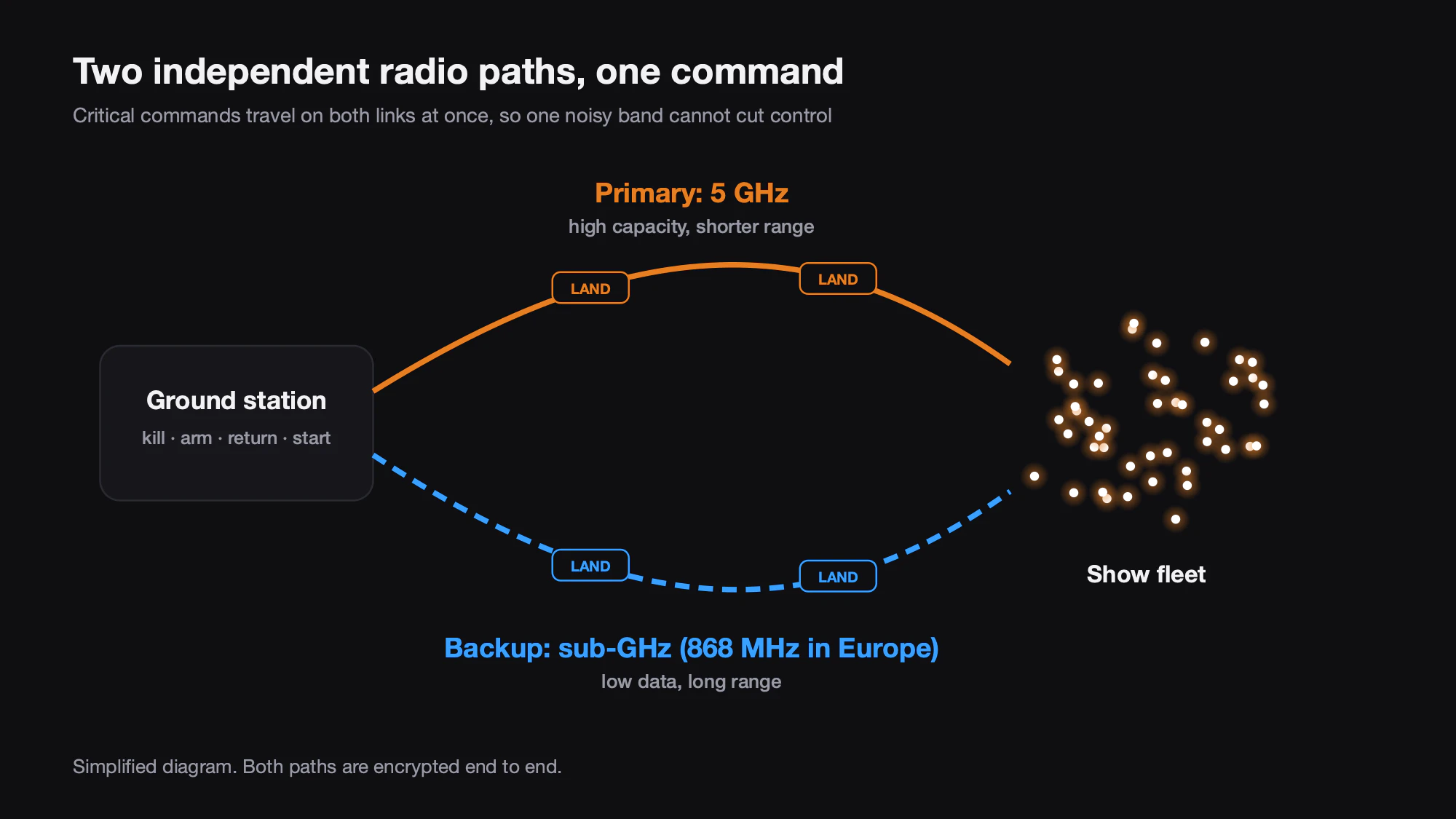
A single link is a single point of failure. The robust pattern is two independent paths on different bands, so that whatever degrades one, whether crowd absorption at 5 GHz or a noisy patch of spectrum, is unlikely to degrade the other in the same way. Our NOVA aircraft combine a 5 GHz Wi-Fi link with a range of up to 800 m and an 868 MHz LoRa backup with a range of up to 2 km, and they can be powered on and off remotely by IR and radio, so a whole dock wakes up without anyone handling a drone. In PILOT, safety-critical commands such as kill, arm and return-to-home go out on the primary and backup paths at the same time, encrypted end to end.
Encryption alone is not the whole job. A show link must also be authenticated, so that a drone accepts commands only from its own ground station, and protected against replay, so that a genuine “land” recorded earlier cannot be played back later. Above a crowd, a spoofed command is a safety problem, not just a security one.
Before the show: scan, place, see
Our radio plan for a site follows three steps.
- Scan. Survey the spectrum on site in every band you plan to use, once early and again with the LED walls, lighting, production radio and broadcast systems running. That second scan is the spectrum you will actually fly in. Share your frequencies with the event’s RF coordinator; they are protecting their own links too.
- Place. Put ground antennas high, above the heads of the crowd, and away from LED walls and production transmitters. Every metre of height removes bodies from the path.
- See. Keep clear line of sight from the antennas to the whole flight volume, including the lowest parts of the choreography and the landing grid. If a structure blocks part of the volume, move the antenna or add another.
When the link goes quiet
Because the show lives on the aircraft, a brief loss of telemetry or command link does not have to end the performance. Losing telemetry for a moment mostly costs the operator visibility. Losing the radio that carries RTK corrections is far more serious, because aircraft lose precise positioning. That distinction is the right way to think about link loss: what matters is not whether a packet arrived, but whether the drone can still fly its path safely.
So link-loss logic should be decided in advance, per aircraft, in software. In the safety approach we use, loss of link, low battery and leaving the safety envelope each trigger a predefined action, such as hold, return-to-home or a controlled descent, while the rest of the show continues. Geofences sit behind that as a final boundary. The radio is there to keep the operator in control; the aircraft has to know what to do when it is not.
If you are planning a show at a busy venue and want to talk through the radio side, get in touch.