Drone show rules in Europe: how EASA authorisation works
Why drone shows fall in EASA's specific category, what SORA 2.5 asks for, how national authorities and cross-border approvals work, and how the US compares.

In this article 7 sections
Every drone light show flown in the European Union sits on the same legal base: Commission Implementing Regulation (EU) 2019/947. What changes between countries is who reads your file, how long they take and which local conditions they add. Here is how the system works for show operators in 2026.
This article describes the framework; it is not legal advice. Rules and national procedures change, so always confirm current requirements with your national aviation authority before you plan a show.
Why a light show is a “specific” category operation
Regulation 2019/947 sorts drone operations into three categories: open, specific and certified (Article 3). The open category needs no prior authorisation, but only if every condition in Article 4 is met. Those conditions are a class-marked or privately built aircraft under 25 kg, visual line of sight, a height of no more than 120 m, no dangerous goods, no dropping of material, and never flying over assemblies of people. The regulation defines those as gatherings so dense that people cannot move away.
A show with hundreds of aircraft beside a festival crowd, often carrying pyrotechnics, fails several of them. The European standard scenarios are no shortcut either: STS-01 and STS-02 call for C5 or C6 class-marked aircraft and one aircraft per remote pilot. That leaves the specific category. Under Article 5 and point UAS.SPEC.030 of the Annex, the operator needs an operational authorisation from the competent authority of the Member State where it is registered. The exception is an operator holding a Light UAS Operator Certificate (LUC) with privileges to authorise its own operations.
Who decides: your national aviation authority
EASA writes the rules; national authorities apply them. EASA’s specific-category page states that the authorisation comes from the authority of the state of registration, even when the show takes place elsewhere. Some examples of how that works in practice:
- Romania: the Romanian Civil Aeronautical Authority (AACR) runs operator registration and pilot testing through uas.caa.ro and, according to EASA’s list of national authorities, takes authorisation applications by email.
- France: operators register on AlphaTango and apply through the METEOR platform; the DSAC, the safety directorate of the DGAC, issues authorisations.
- Germany: operators register with the Luftfahrt-Bundesamt (LBA). Depending on where the operator is based, either the LBA or the aviation authority of the federal state issues the authorisation; LUC holders always go to the LBA.
National authorities can also adapt some EU requirements. Point UAS.SPEC.050 normally requires every specific-category aircraft to carry a green flashing light at night and an active remote identification system. In May 2025 the French DSAC granted a derogation for swarm shows, valid until 30 April 2027, that lifts both requirements. Its reasoning: show lighting already makes the fleet visible, and hundreds of identical remote ID signals add little and congest the radio band. The conditions are that the show is flown in visual line of sight and entirely over a controlled ground area, and that the operator notifies the DSAC first.
Registration comes first. Under Article 14, an operator registers once, in the Member State of its residence or principal place of business. In the specific category this applies whatever the aircraft’s mass, and the registration number goes on every aircraft.
SORA 2.5: the risk assessment behind the authorisation
Article 11 requires a risk assessment that describes the operation, identifies ground and air risks, and proposes mitigations of sufficient robustness. EASA’s accepted method is the Specific Operations Risk Assessment (SORA). ED Decision 2025/018/R, published on 29 September 2025, brought the JARUS SORA 2.5 package into EASA’s guidance. The Easy Access Rules revision of June 2026 consolidates it. The earlier SORA 2.0 decision was not repealed, so each authority manages its own transition. Finland’s Traficom, for example, accepts only SORA 2.5 for new applications from 31 March 2026. Ask your authority which version it expects.
SORA 2.5 runs in ten steps. The parts that matter most for a show:
- Ground risk. The intrinsic ground risk class comes from the aircraft’s size, its maximum speed and the population density beneath the operation. A controlled ground area, where only involved people are present, gives the lowest class. The operator is fully responsible for keeping it clear.
- Air risk. The airspace sets an initial air risk class, which strategic and tactical mitigations can lower. In controlled airspace or near aerodromes, expect to need prior approval from the air navigation service provider.
- SAIL. Ground and air risk combine into a Specific Assurance and Integrity Level, from I to VI. The SAIL sets how robust your operational safety objectives must be. It also sets how the aircraft design is shown to comply: an EASA design verification report at SAIL IV, and a type certificate at SAIL V and VI.
EASA’s text addresses shows directly. Where multiple aircraft fly relative to each other, “such as displays for entertainment”, it recommends examining common-mode failures and adapting the SORA with the authority. Drone-to-drone collision is not yet covered by the method, but operators are expected to have their own deconfliction strategy.
What goes into an application
Point UAS.SPEC.030 lists the minimum: operator registration number, accountable manager, the risk assessment, the proposed mitigations, an operations manual where the risk calls for one, and confirmation of insurance where law requires it. For a show, most of the work goes into the following.
Concept of operations
The ConOps describes the show as it will fly: site, number of aircraft, heights, duration, launch area, crew roles, and normal, contingency and emergency procedures, including the emergency response plan.
Volumes and crowd distances
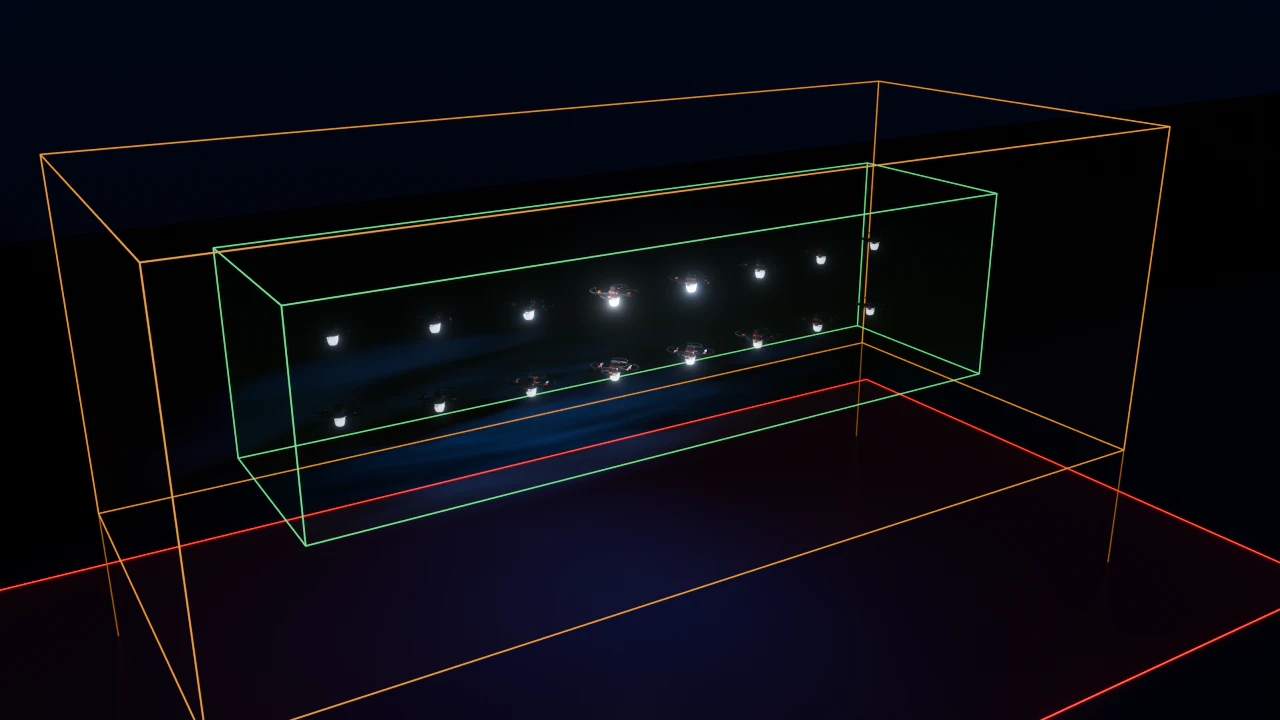
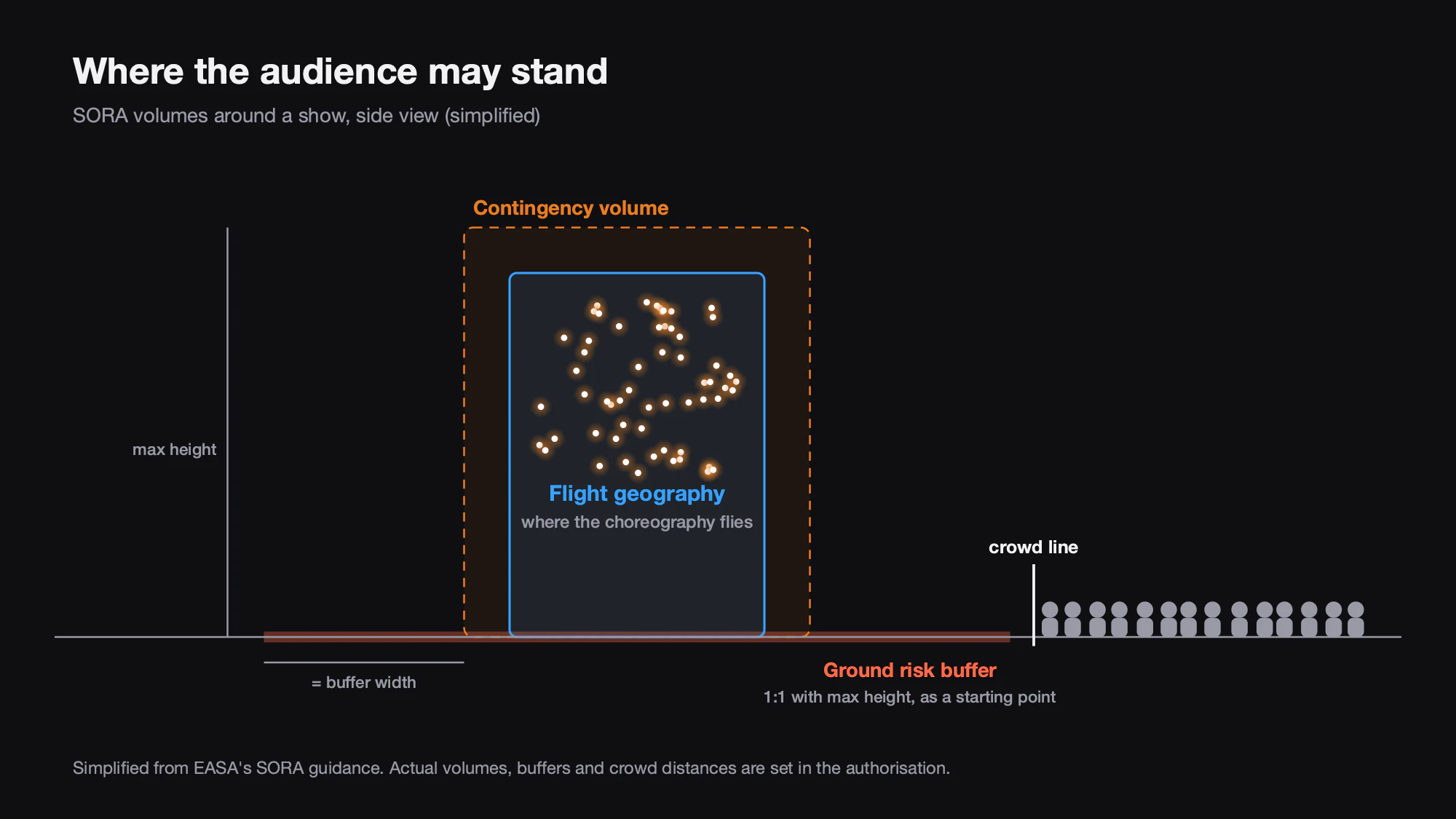
SORA builds three nested spaces. The flight geography holds the choreography, with margins for navigation error and latency. The contingency volume around it is where abnormal-situation procedures begin. The ground risk buffer beyond that is where a drone that leaves the contingency volume is expected to come down. EASA’s starting point is the 1:1 principle: a buffer as wide as the maximum height of the operational volume. For multirotors, a ballistic calculation acceptable to the authority may justify less. EU law sets no single crowd distance. Spectators stay outside the volumes and the buffer, and you must show how that ground is kept clear.
Containment
Step 8 sets the required robustness of containment, from low to high. Two things drive it: the population density out to the distance the aircraft could fly in three minutes (at least 5 km), and the size of any outdoor assembly within 1 km of the operational volume. At a show, that assembly is usually your audience. For an aircraft up to 1 m across at SAIL I or II, EASA’s table calls for medium containment if 40,000 to 400,000 people are within that kilometre, and high containment if more are.
Crew competence
Article 8 leaves pilot requirements to the authorisation but sets a floor. Pilots must be competent in normal, contingency and emergency procedures, communication, flight path and automation management, teamwork, decision-making, situational awareness, workload management and handover. Point UAS.SPEC.050 makes the operator responsible for competency-based training, so your crew structure and syllabus are part of the file.
Containment is where aircraft and software must back up the paperwork. Our PILOT fleet software layers soft, hard and ballistic geofences with physical and PIN-protected virtual kill switches, and the system is engineered to EASA and FAA rules. The authority still judges every application on its own merits.
A European show authorisation is a risk case, not a form. The authority approves your volumes, your containment and your crowd control for a defined operation, so change any of them and you may need to change the authorisation.
Timelines and cross-border shows
The regulation sets no fixed processing time. Germany’s federal portal gives 2 to 24 weeks depending on the SAIL, and an LBA authorisation is valid for two years. France asks operators planning cross-border work from France for three months’ notice, and foreign operators already authorised elsewhere for one month. Treat these as indicative and contact your authority early.
For a show in another Member State, Article 13 applies. An authorisation from one Member State is valid elsewhere in the EU, but not automatically. The operator applies to the authority of the country where the show will take place. The application includes a copy of the home authorisation, the locations, and any updated mitigations for local airspace, terrain, population and climate. That authority must assess it promptly and confirm, and only then may the operation start. EASA provides a standard application form and confirmation form for this. An LUC holder with self-authorisation privileges instead sends the host authority its terms of approval and the locations.
Pyrotechnics: a separate legal layer
Aviation law treats explosives as dangerous goods. The open category bans them outright. EASA’s guidance excludes carrying explosives from the scope of SORA and notes that additional safety considerations may be needed. The fireworks themselves fall under different law. Directive 2013/29/EU governs placing pyrotechnic articles on the market. It restricts professional categories such as F4 and T2 to persons with specialist knowledge, as each Member State defines them. Use and storage remain under national explosives law. In Germany, for example, the Sprengstoffgesetz requires a certificate of competence for the responsible person. A pyro show therefore needs both the aviation authorisation and the explosives permissions, usually from different bodies.
The US approach and industry standards
A waiver issued in July 2026 shows the current FAA template. It waives 107.35 and the anti-collision light rule in 107.29, allows up to 500 aircraft, and requires a second certified remote pilot plus one visual observer per 100 aircraft. It sets four zones: flight area, soft geofence (return or land), hard geofence (motors off), and a restricted area sized by a free-fall formula. Local FAA notification is due 72 hours ahead, and the waiver also grants relief from the remote ID operating rule, much as France has done. The FAA aims to decide waiver requests within 90 days. Its beyond-visual-line-of-sight proposal, Part 108, was published in August 2025. It acknowledges light shows flown under 107.35 waivers and proposes a 500 ft setback from people for demonstration flights. We could not confirm a final Part 108 rule at the time of writing, so check its status before relying on it.
Industry is also writing its own standards. ASTM subcommittee F38.02 has an open work item, WK95240, for a drone show operations practice; its stated rationale is that the FAA has encouraged industry to set minimum safety requirements. It has no regulatory force in Europe, but it is a useful benchmark for a SORA safety case.
If you are preparing a first application or taking a show across a border, our EASA authorisation support can help you build the file.