Drone show batteries: the hidden logistics behind every fleet
Hundreds of packs, one show minute. How fleets choose LiPo or Li-ion, charge on site, store, track health, fly in the cold and ship batteries legally.

In this article 8 sections
Audiences see the formations. Crews spend much of their day on batteries. A show with 500 drones means 500 packs, all charged, balanced and healthy at the same minute, often after a road trip, sometimes on a cold night, and sometimes twice in one evening. One weak pack lands early and leaves a gap in the picture. Regulators care about this too: the FAA’s current light-show waiver template requires the ground station to show battery condition for every aircraft, and it counts low-battery and overheat landings among the expected failsafes.
This article is about that hidden layer. It covers chemistry, charging, storage, health tracking, cold, transport rules, fire safety, and the choice between removable packs and docks.
The scale problem
Take a pack of four cells in series (4S) with 3,000 to 3,500 mAh, the range our own show drones use. At a nominal 3.6 to 3.7 V per cell, that is roughly 43 to 52 Wh per pack. Multiply by 500 and the fleet holds about 22 to 26 kWh, all of which must go back in before the next show.
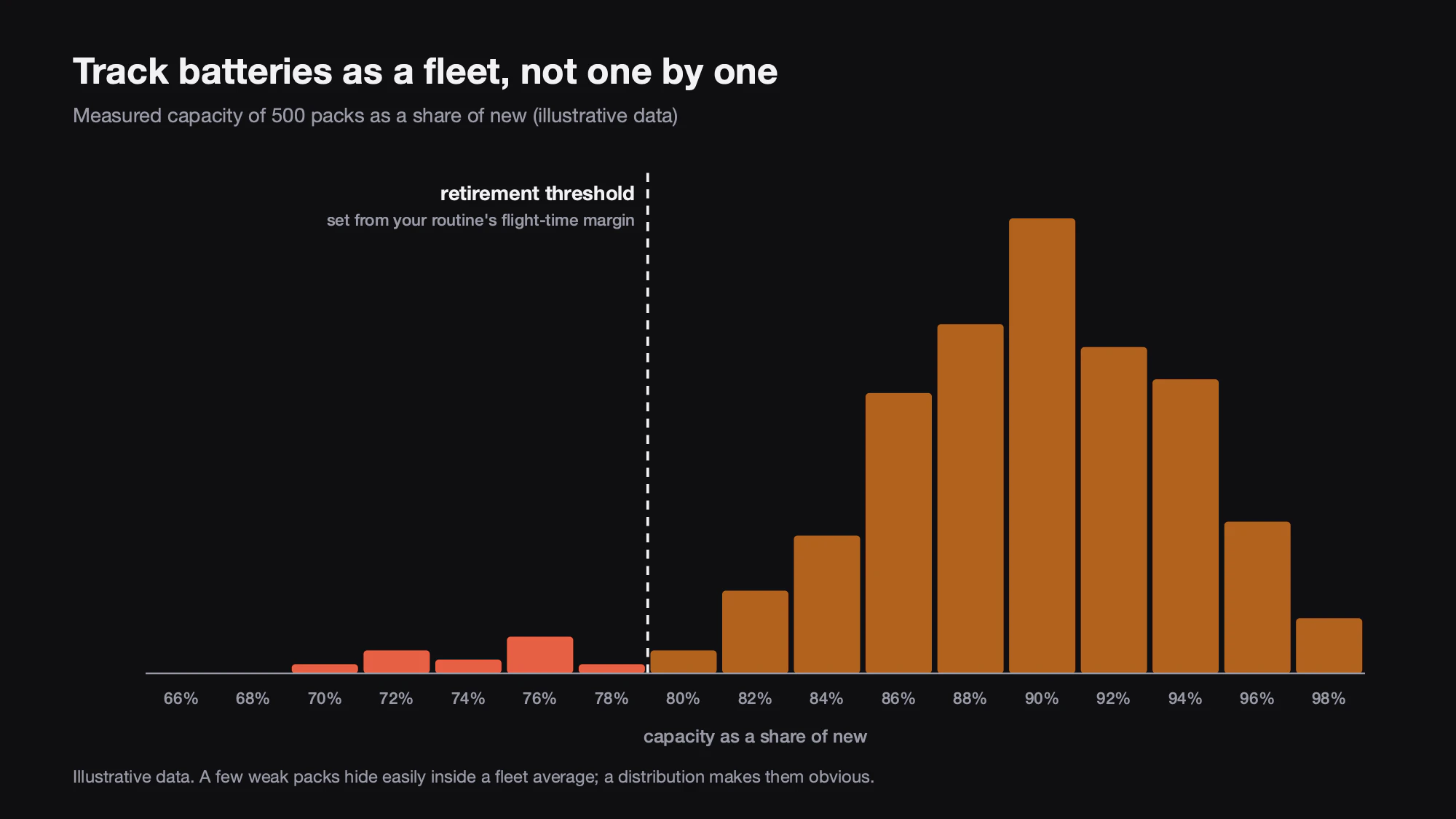
The energy is the easy part. The hard part is uniformity. Every pack in the fleet has its own history of cycles, temperatures and storage time, and the show only works if the worst pack can still fly the whole routine. Cells inside each pack must stay matched as well, which is why smart packs track cell balance. For the same reason, we look at battery data as a fleet distribution rather than one pack at a time. Our PILOT software shows battery voltage across the fleet as a distribution, so one weak drone shows up as an outlier without hiding that the rest of the fleet is fine.
LiPo or Li-ion: what a fleet trades
Both are lithium-ion chemistries. In drone use, “LiPo” usually means pouch cells built for high current, and “Li-ion” means cylindrical cells such as the 21700 size, built for energy density. In general, high-power LiPo packs give more current headroom and faster charging, while high-energy cylindrical cells carry more energy per gram.
Which suits a fleet depends on the operation. A show drone mostly hovers and moves at moderate speed, so it rarely needs extreme currents, and energy per gram turns directly into flight time; that favours high-energy cells. LiPo packs bring high-current headroom, fast charging and a mature range of removable smart packs that are quick to swap between shows. Cycle life depends as much on use as on chemistry. Battery University’s tables show cycle counts rising sharply as depth of discharge and peak charge voltage fall.
We build both. NOVA uses an internal 4S 3000 mAh Li-ion pack, and GP4 2.0 uses a removable 4S 3500 mAh smart LiPo with charging protection, built to last hundreds of charge cycles. Both fly for up to 20 minutes, and both are sound approaches.
Charging on site: power, generators and staggering
Lithium-ion packs charge at constant current, then at constant voltage while the current tapers. Battery University puts a full charge of energy cells at roughly two to three hours at 0.5C to 1C. Faster “charge-and-run” methods reach about 85% in an hour or less. A 1C rate means a current equal to the pack’s capacity, so a 3.5 Ah pack charges at 3.5 A.
Translate that into site power. At 1C, a 4S pack near the top of its charge draws roughly 50 to 60 W. Five hundred packs charging at once would need about 25 to 30 kW at the packs, before charger losses. Halve the rate and the power halves, but the time roughly doubles. That calculation sets the size of the generator or grid connection. It also explains why crews stagger charging: in batches, by priority, and with the first show’s packs started early in the day.
Temperature limits apply to charging as well. Battery University gives 0 to 45°C as the charging range for standard Li-ion and advises reducing the current below 5°C. Charge on a heat-resistant surface, and never leave charging unattended. In practice, packs that come down hot from a show should cool before they go back on charge, and packs from a cold van should warm up first.
Cold nights
Cold raises internal resistance. Battery University notes that a battery delivering full capacity at 27°C typically delivers about half at -18°C, and that the loss reverses once the battery warms. For a show, the bigger risk is voltage sag under load, which can trigger low-battery failsafes mid-routine. Charging below freezing is worse than flying cold: it can plate metallic lithium onto the anode and permanently degrade the cell’s performance and safety.
Between events: storage, health and retirement
Lithium packs should not sit full. Battery University recommends storing at about 40% charge, around 3.82 V per cell at rest, ideally at about 15°C. Its figures show why. After a year at 25°C, a cobalt-based cell kept at 40% retains about 96% of its capacity. Kept at 100%, it retains about 80%. In practice, bring packs to storage level if they will sit for more than a few days, and check them every few months. After a cancelled show, discharging to storage voltage is part of packing up.
Health tracking needs a record per pack: cycle count, measured capacity, cell balance and internal resistance. Internal resistance is useful as a trend from new, but Battery University warns that it is not a capacity measurement and can stay flat for much of a cell’s life. Pair it with a periodic capacity test. Definitions of “worn out” also differ: some makers rate cycle life to 80% retention, others to 70%. Set your own threshold from the flight-time margin your routine needs, then retire any pack below it. Retire immediately any pack that is swollen, damaged or leaking.
Transport: UN 38.3, UN3480/UN3481, air and road
Every lithium cell and battery design must pass the tests in sub-section 38.3 of the UN Manual of Tests and Criteria. These include altitude simulation, thermal cycling between 72°C and -40°C, vibration, shock, short circuit and crush. Manufacturers and distributors must make a test summary available. Ask for it before you buy.
Packs shipped on their own are UN3480. Packs packed with drones, or installed in them, are UN3481. For air, the IATA 2026 guidance sets out four key points:
- UN3480 is forbidden as cargo on passenger aircraft and must ship at no more than 30% state of charge.
- Since 1 January 2026, batteries packed with equipment above 2.7 Wh must also ship at no more than 30%.
- For batteries contained in equipment, 30% is strongly recommended.
- Standalone lithium-ion batteries must not share an outer package with most explosives (Class 1 other than 1.4S). Pyro crews should note this.
Damaged or defective batteries are forbidden by air altogether.
On European roads, ADR applies. Under special provision 188, lithium-ion batteries of up to 100 Wh (cells up to 20 Wh) are exempt from most ADR rules if they meet several conditions:
- the battery type is UN 38.3 tested;
- the watt-hour rating is marked on the case;
- terminals are protected against short circuit;
- the outer packaging is strong and carries the lithium battery mark;
- each package survives a 1.2 m drop and weighs no more than 30 kg gross.
Batteries above 100 Wh are fully regulated Class 9 dangerous goods, and damaged packs travel under special provision 376.
Fire safety in storage and charging
German insurers’ guidance VdS 3103 treats lithium batteries as hazardous material. Even for packs up to 100 Wh, it calls for the following:
- protected terminals;
- protection from mechanical damage and heat;
- at least 2.5 m from other combustibles where there is no automatic extinguishing system;
- immediate removal of damaged packs to a safe, separated spot;
- storage only of UN 38.3-tested batteries.
Larger stocks, above about 7 m³ or six Euro pallets, move up to 5 m or fire-resistant separation with fire detection. VdS also notes that fast firefighting with water in the first minutes gives a good chance of control, and that packaging adds to the fire load. For a show crew, that means charging on non-combustible surfaces, never leaving charging unattended, and keeping a clear quarantine spot for any pack that swells or heats up.
Removable packs or docks
The last choice shapes the whole operation.
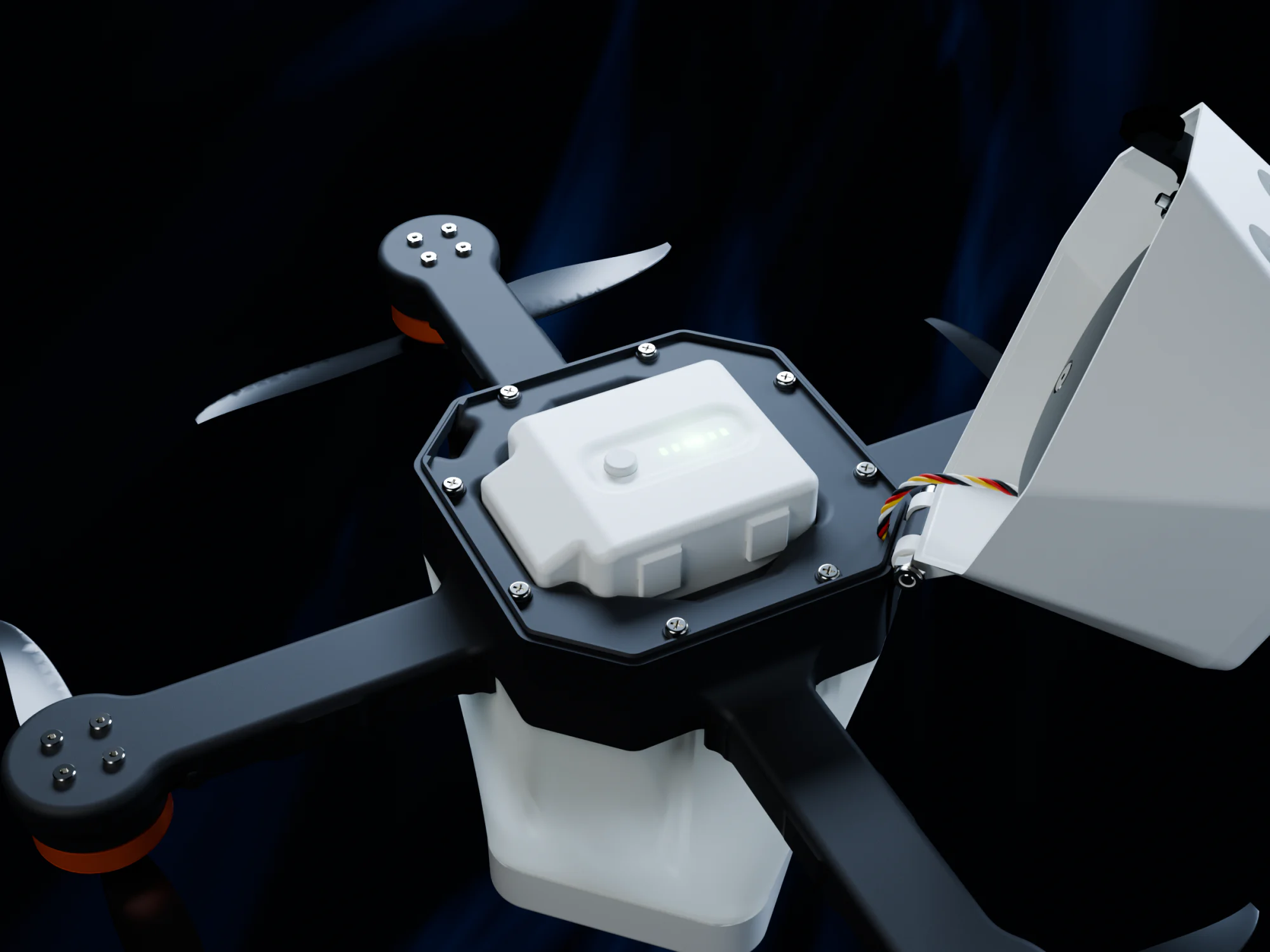
Removable packs, as on GP4 2.0, separate battery logistics from the aircraft. Crews can charge off the airframe in a controlled area, swap in fresh packs between shows and retire a tired pack without touching the drone. The cost is more objects to buy, track, transport and handle. Two shows in one night often means two sets of packs.
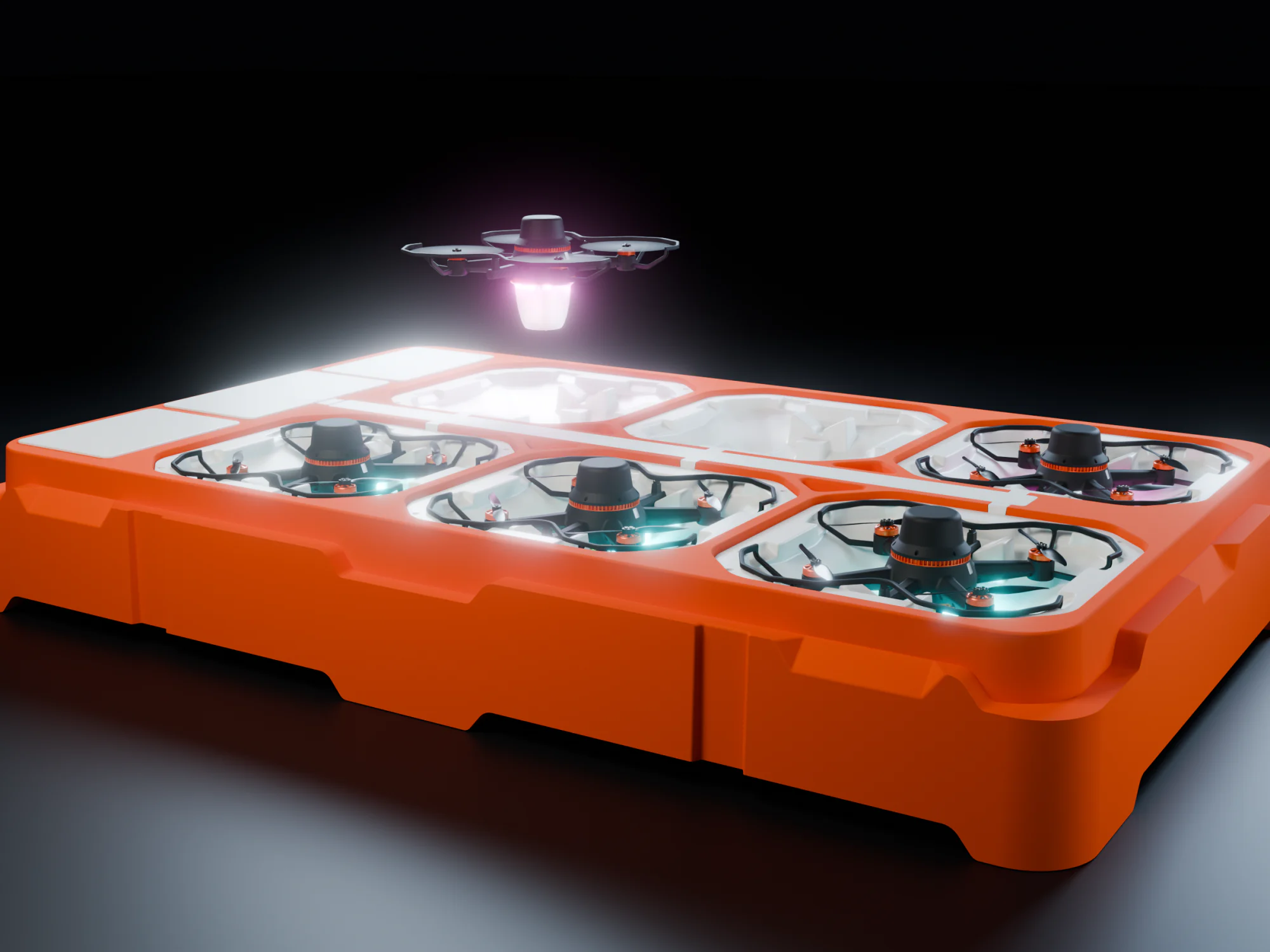
Docks, as with NOVA, keep the battery inside the airframe. Each drone lands, charges by contact and launches again from a stackable six-drone dock. There are no loose packs to place, count or ship separately, and much less handling on the field. In exchange, charging power has to reach the docks wherever they sit, and pack health becomes aircraft health, because the two age together.
Neither model removes the battery work. Each one moves it: to the charging bench, or to the dock and its power supply.
The right answer depends on show cadence, crew size and how you travel. If you are weighing the two for your fleet, talk to our engineers.