Drone shows vs fireworks: an honest engineering comparison
We build LED drones and pyro drones, so we can say where each wins: impact, storytelling, noise, fire risk, cost over time, weather and regulation.

In this article 8 sections
Most comparisons of drone shows and fireworks are written to sell one of them. We are in an unusual position: we build LED show drones and we build drones that carry pyrotechnics, so we have no reason to pretend either one wins everywhere. This is the comparison we give event producers when they ask what to book, criterion by criterion, including the places where a traditional fireworks display is still the better buy.
A note on numbers before we start. The prices below are vendor and press estimates, not quotes. They vary widely by country, season and design; treat them as orders of magnitude, not a price list.
At a glance
| Criterion | LED drone show | Fireworks display | Pyro on drones (hybrid) |
|---|---|---|---|
| Visibility and sheer impact | Good within the designed viewing area; images read best from the front | Excellent; bright, loud, visible from anywhere around the site | Strong locally; effects are smaller than large ground-launched shells |
| Storytelling and branding | Excellent: text, logos, figures, animation | Limited: colour, rhythm and shape families | Excellent: LED images plus sparks placed exactly in 3D |
| Noise | Propeller hum near the launch area; music carries the show | Very loud by design | Quieter than large shells, louder than LED-only |
| Wildlife and pets | No blast; propeller noise stays local | Well-documented disturbance | Reduced, not removed |
| Wildfire risk | No combustion; risk is a falling aircraft | Real ignition source, restricted in dry seasons | Ignition source returns, in a known location |
| Debris, smoke and residue | None from the effect itself | Smoke, particulates, casings, chemical residue | Some smoke and residue, at smaller scale |
| Reusability | Aircraft fly show after show | Product is consumed every show | Aircraft reused; pyro consumed |
| Cost for one small show | Higher entry price | Usually more minutes per euro | Usually the highest |
| Weather sensitivity | Wind-limited per aircraft rating; rain depends on airframe | More wind-tolerant; dry conditions and wind direction matter | Both sets of limits apply |
| Regulatory burden | Aviation authorisation | Pyrotechnic licensing and local permits | Both |
Picture versus impact: visibility, storytelling and branding
Fireworks are chemistry released at altitude. A large shell fills a wide piece of sky, it looks roughly the same from any side of the site, and it is visible across a whole city. Nothing else gives that much raw impact per launch, and it needs no viewing angle: whoever looks up sees the show.
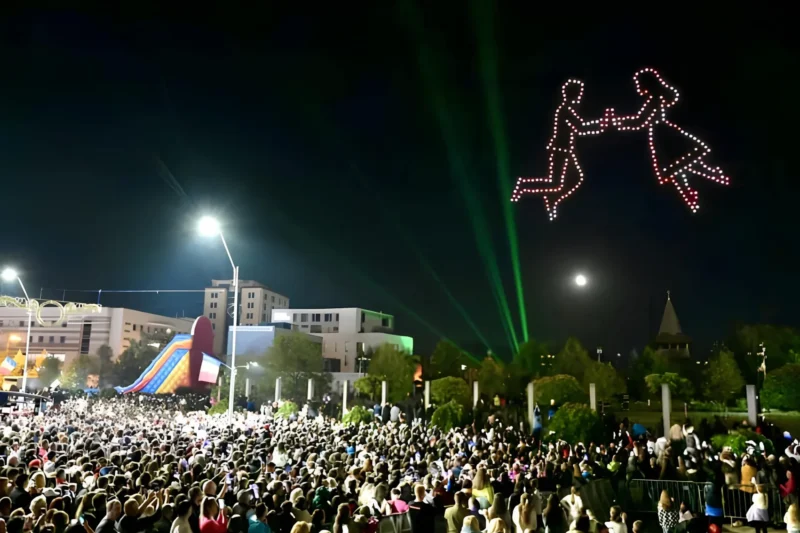
A drone show is a different medium. Hundreds of programmable points of light, each held at a known position in three dimensions, can draw words, a logo, a face, a map, or an object that turns and morphs in time with music. That is why brands and city festivals use them: the sky can say something specific. The trade-off is geometry. A drone image is designed for a main audience direction, and viewers far off to the side see it foreshortened or scrambled. Good design picks the audience axis early and favours shapes that survive off-axis viewing, but the effect never disappears completely.
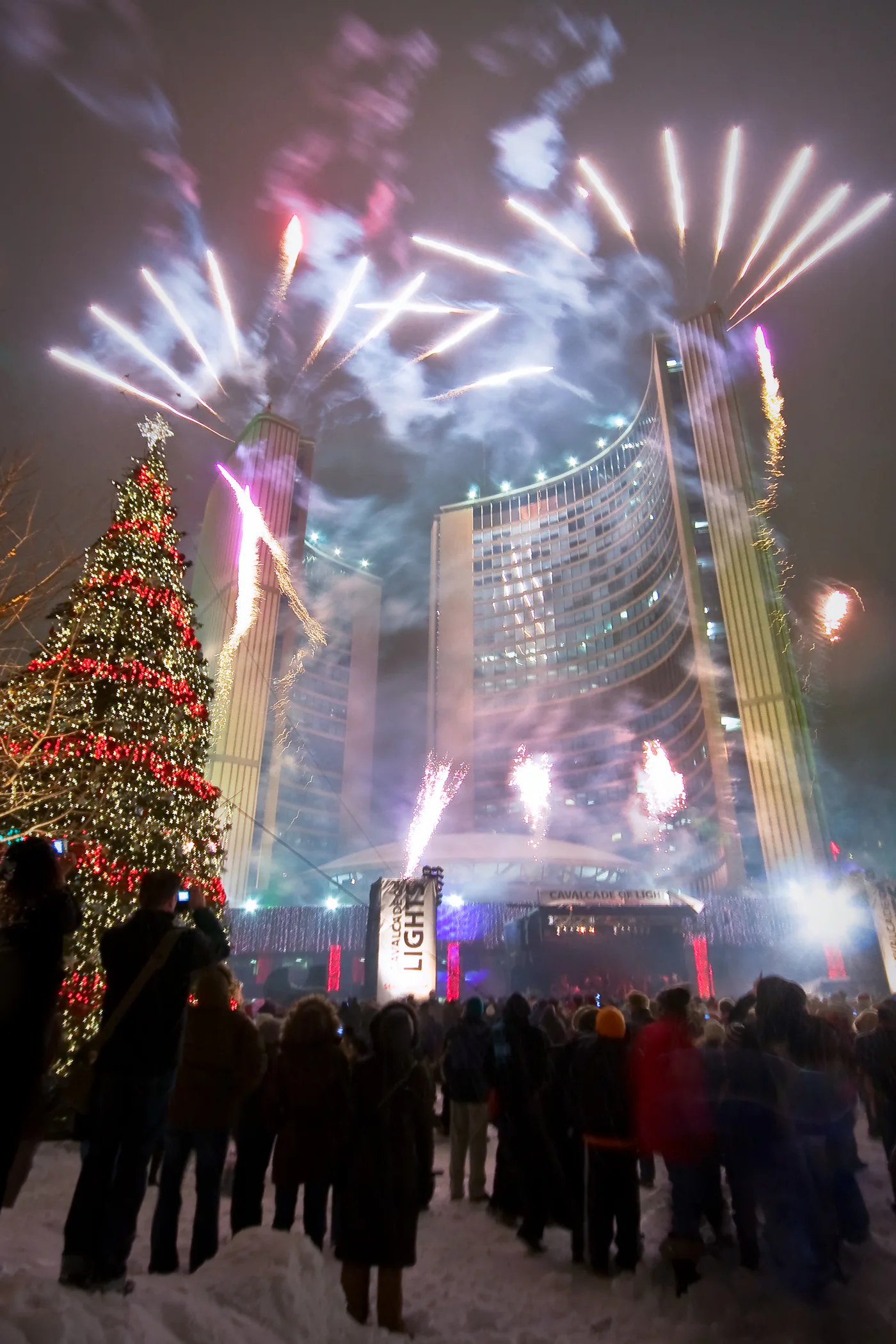
For storytelling, drones are in a different class. For a single moment of collective awe, fireworks are still hard to beat.
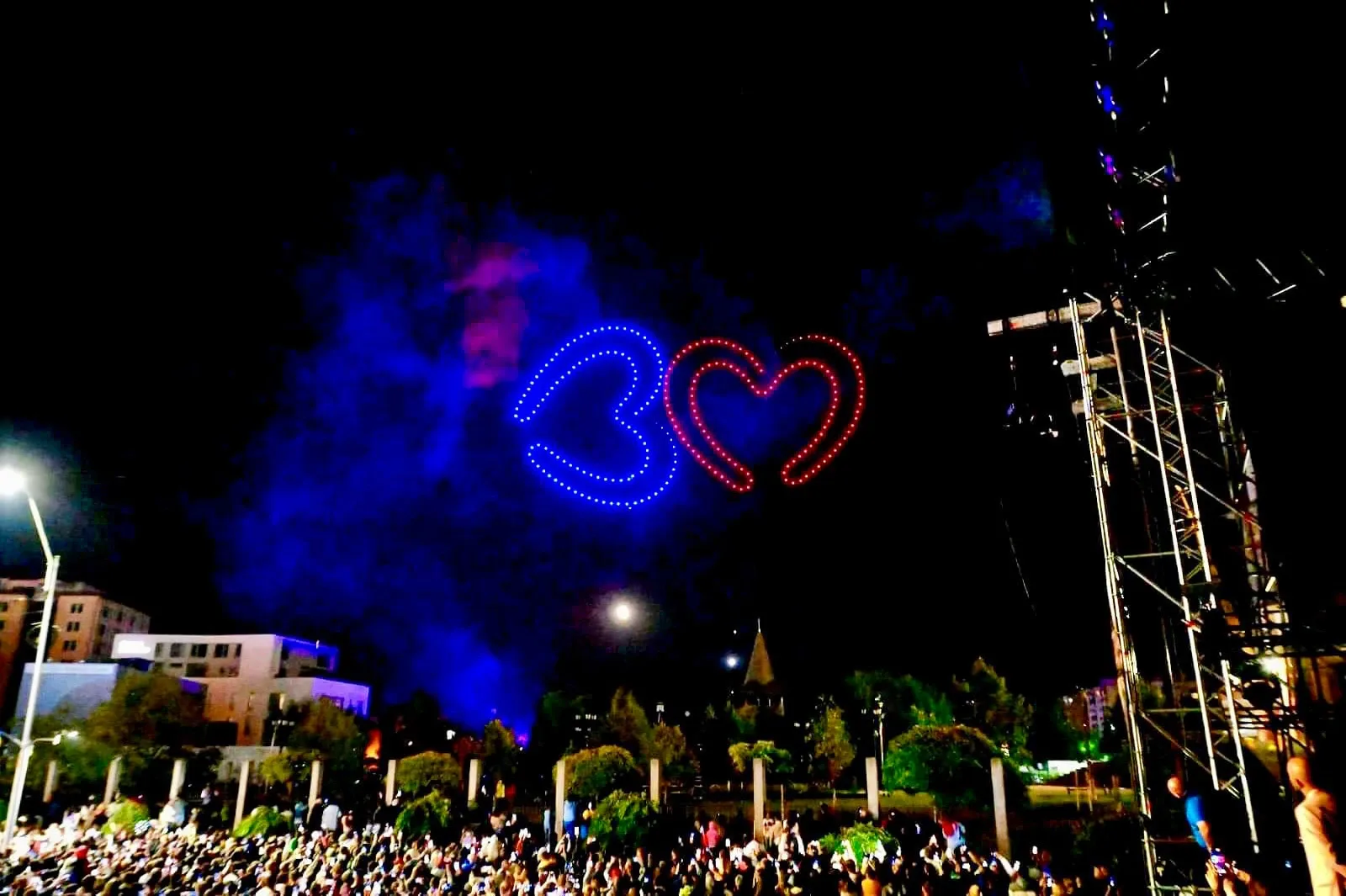
Noise, wildlife and pets
Loudness is part of what people love about fireworks. It is also their main side effect. UK charity Action on Hearing Loss, as reported by EHS Today, put fireworks at roughly 125 to 155 dB at about three metres, with public displays averaging around 150 dB.
Animals feel it too. In a University of Bristol study funded by the RSPCA, almost half of the dog owners interviewed reported at least one typical fear behaviour in response to noises, while only about a quarter had described their dog as fearful. Wild birds react strongly as well: a 2023 study in Conservation Letters tracked 347 wild geese by GPS over eight New Year periods and found they flew on average 5 to 16 km further and 40 to 150 m higher on New Year’s night, and changed their feeding and movement for days afterwards.
An LED drone show has no blast. The audible part is the propeller hum near the launch area, and the music system carries the show. The honest downside: some crowds miss the thump in the chest, and without good sound design a drone show can feel thin.
Fire, debris and smoke
Fireworks are an ignition source. According to NFPA figures cited by IBHS, fireworks set off by amateurs caused an estimated 19,500 fires in the US in 2018, and July 4 is the peak day for fireworks-started brush, grass and forest fires. To be fair to professional display operators, those figures are dominated by consumer use, not licensed shows. Still, in dry seasons the fire risk alone has pushed several towns in wildfire-prone regions to replace their fireworks with drone shows.
What goes up also comes down. A USGS study at Mount Rushmore concluded that the fireworks displays held there from 1998 to 2009 were the probable source of perchlorate in its water, with the highest stream sample at 54 micrograms per litre against less than 0.2 outside the memorial. In the air, a NOAA analysis of 315 US monitoring sites found fine particulate levels over the 24 hours from 8 p.m. on July 4 were on average 42 per cent higher than on surrounding days.
Drones are not risk-free; their failure mode is different. The aircraft itself can fall. There have been shows where wind beyond the aircraft’s limits sent most of a fleet into the water, and shows where a wrongly placed show centre led to collisions shortly after take-off, with spectators hurt. Both kinds of incident are reminders that a drone show’s safety depends on procedures and software, not only on the absence of explosives.
Cost: one show versus a season
Here fireworks are often the right answer.
On the drone side, published pricing guides put most shows at roughly $200 to $300 per drone, with a practical entry point of around $20,000 to $30,000 for a show of about 100 drones.
On the fireworks side, local press gives a sense of scale. Pine Plains, New York, paid $20,000 for a display of more than 30 minutes in 2024. Traverse City, Michigan, spends about $70,000 on a 27-minute July 4 show of 1,820 pyrotechnic items.
Put those side by side and the conclusion for a single small-town show is clear: the same budget buys more minutes and more raw impact as fireworks. Drone show length is also bounded by battery endurance; our own aircraft are rated for 18 to 22 minutes of flight, depending on the model.
The picture changes over time. Fireworks are consumed every night; a drone fleet is not. An operator flying a season, or a venue running a recurring show, spreads the aircraft cost over many performances and can reuse choreography between them. The running costs that remain are crew, transport, insurance, permits and battery wear.
Weather and regulation
Drones are wind-limited, and every aircraft has a rated limit. Ours range from 8 m/s for NOVA and GP4 2.0 to 15 m/s for the heavier MD6 and MD12. The wind-related losses mentioned above are the cautionary case: the wind exceeded the aircraft’s limits shortly after launch. Rain tolerance varies by airframe. Fireworks are generally less wind-sensitive as a flight problem, but wind direction decides where debris and smoke land, and dry conditions can stop a display entirely.
The paperwork differs in kind. In the EU, a drone show normally needs an operational authorisation in the specific category, issued by the national aviation authority on the basis of a risk assessment such as SORA or a predefined risk assessment. In the US, the Part 107 rule that one person may not fly more than one drone at a time is one of the rules that can be waived, so show operators fly under a waiver. Professional fireworks in the EU are category F4 under Directive 2013/29/EU and may be supplied only to persons with specialist knowledge authorised by a Member State, with national rules on top. A hybrid show should expect both regimes. Always check the current rules with your national aviation authority and pyrotechnics authority.
The hybrid route: pyrotechnics on drones
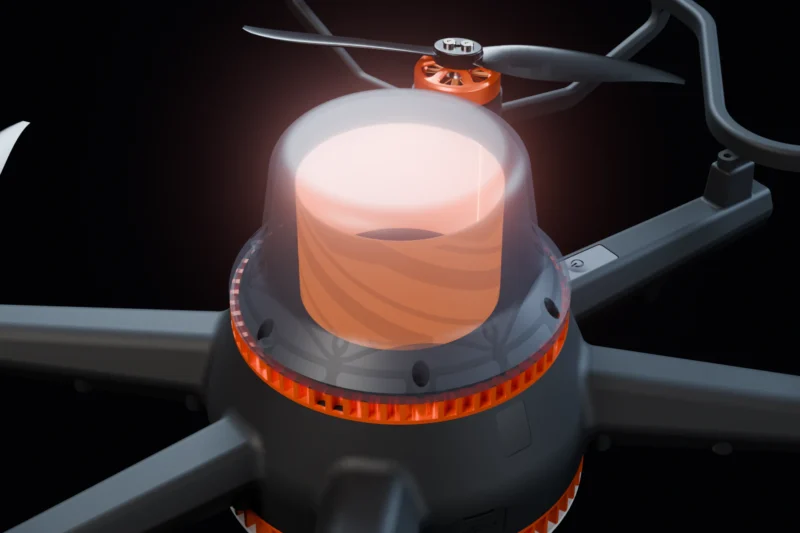
Ground-launched fireworks follow ballistic arcs. Where a shell bursts depends on the mortar angle, the lift charge and the wind. Put the pyrotechnic on a drone and the effect fires from a known point in three dimensions, at a moment set by the show timeline. That makes things possible that ground pyro cannot do: a waterfall that pours exactly from the edge of a drawn shape, comets traced along a figure, sparks that appear where a logo was a second earlier.
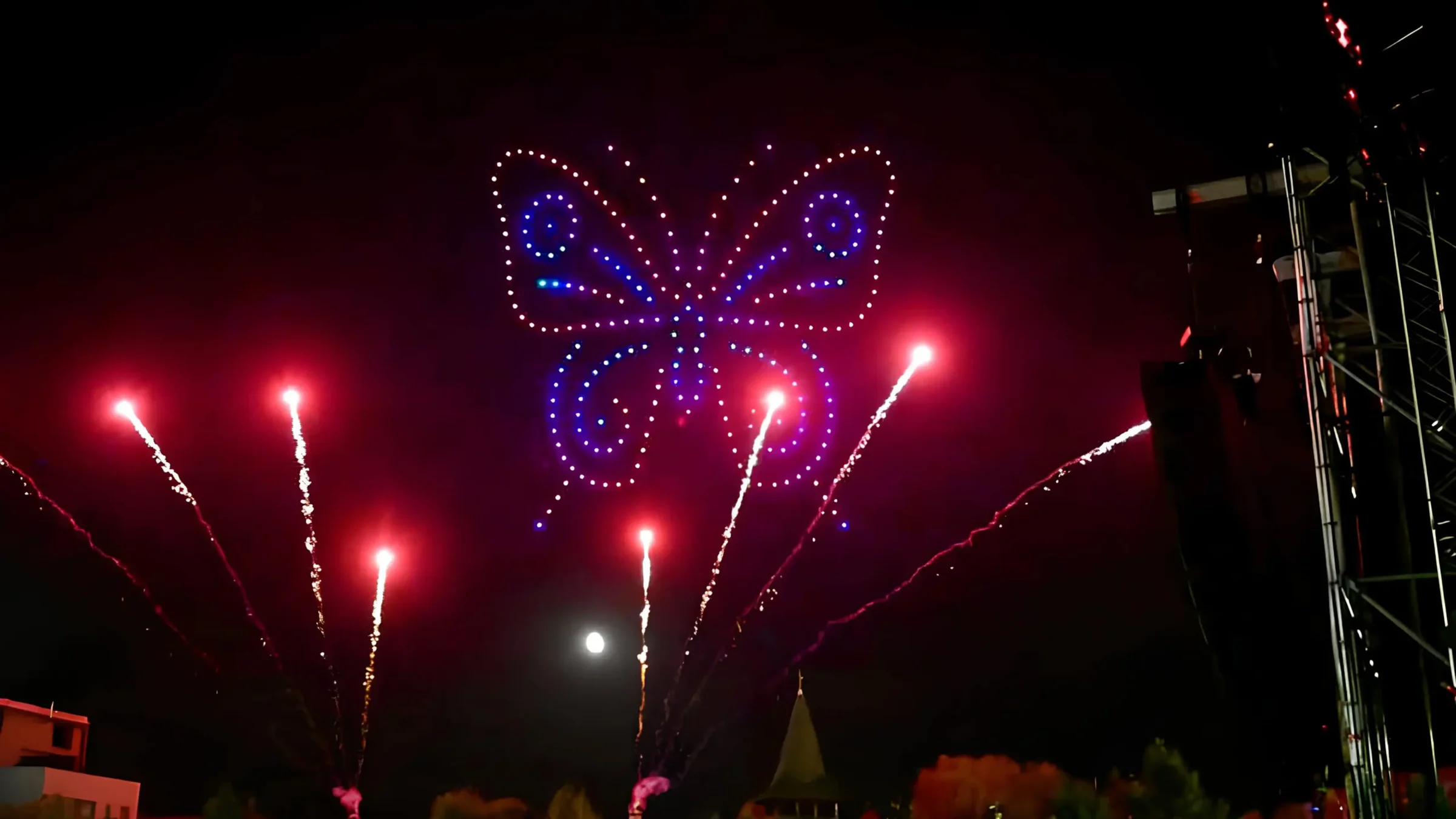
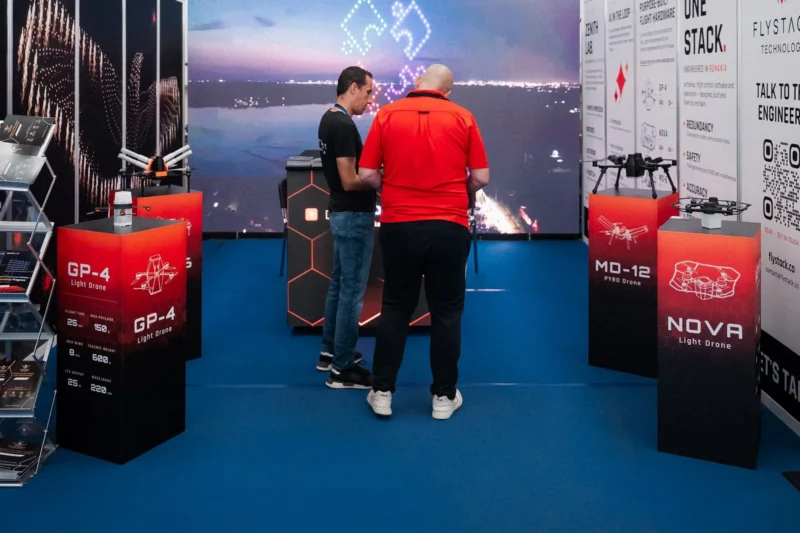
This is the part of our range we built for that job. GP4 2.0 combines an RGBW LED with three channels of built-in pyrotechnics, MD6 carries six firing channels, and MD12 carries twelve with a 750 g payload. All of them are flown from PILOT, whose timeline-locked start keeps the fleet and its cues on one clock.
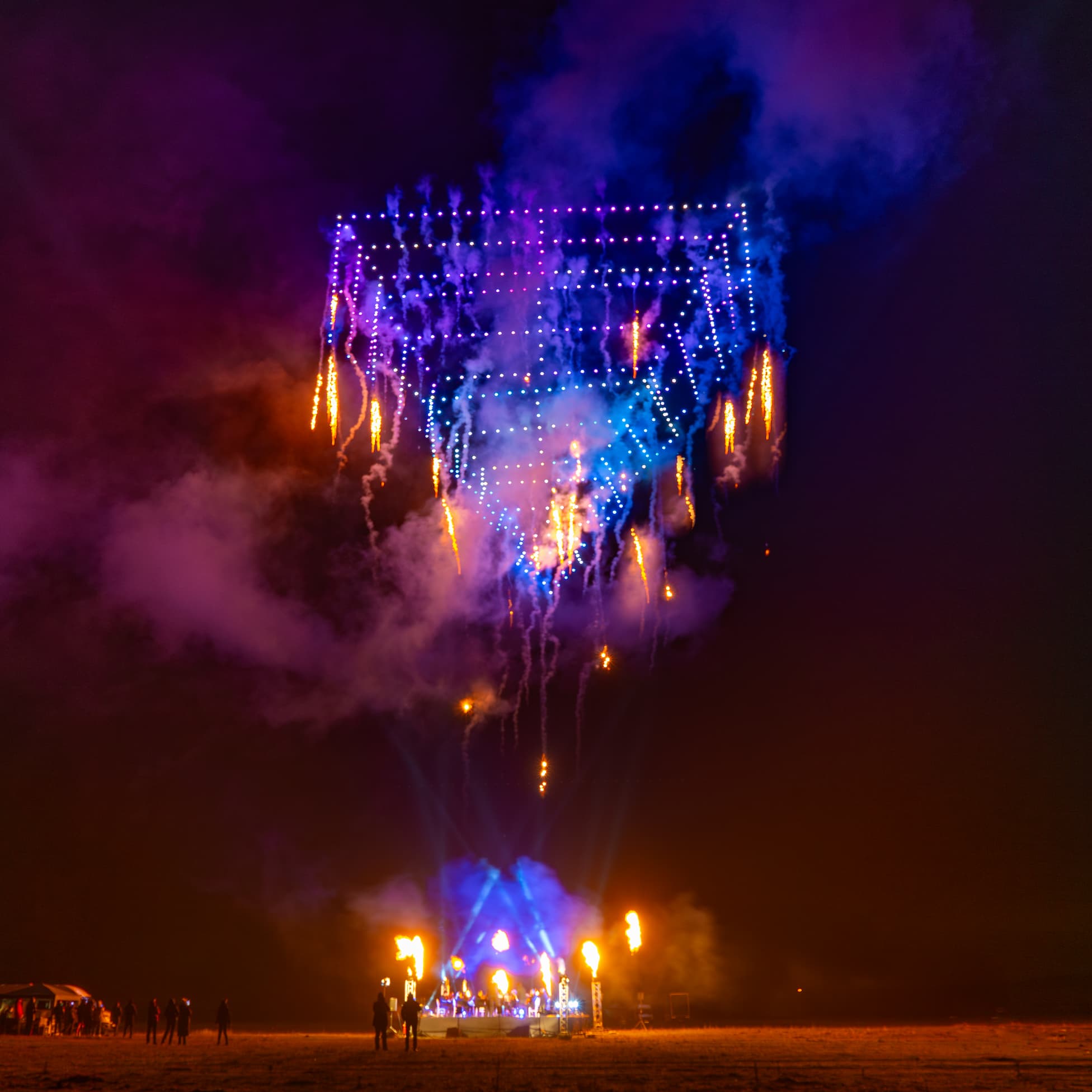
The question is rarely drones or fireworks. It is which moments need a picture and which need a bang.
Two caveats keep this fair. First, a drone’s payload limits the size of the effect: drone pyro is waterfalls, comets, gerbs and mines, not the large shells of a ground display. Second, pyro on drones brings back some of what drones avoid: smoke, residue, noise and an ignition source, smaller and better placed, but present. In a burn ban, a hybrid show is still a pyrotechnic show.
How we would choose
- One evening, small budget, open site, low fire risk: fireworks usually give the most impact per euro.
- A message, a logo or a story: an LED drone show.
- Noise-sensitive venues, wildlife areas, dry seasons: LED drones only.
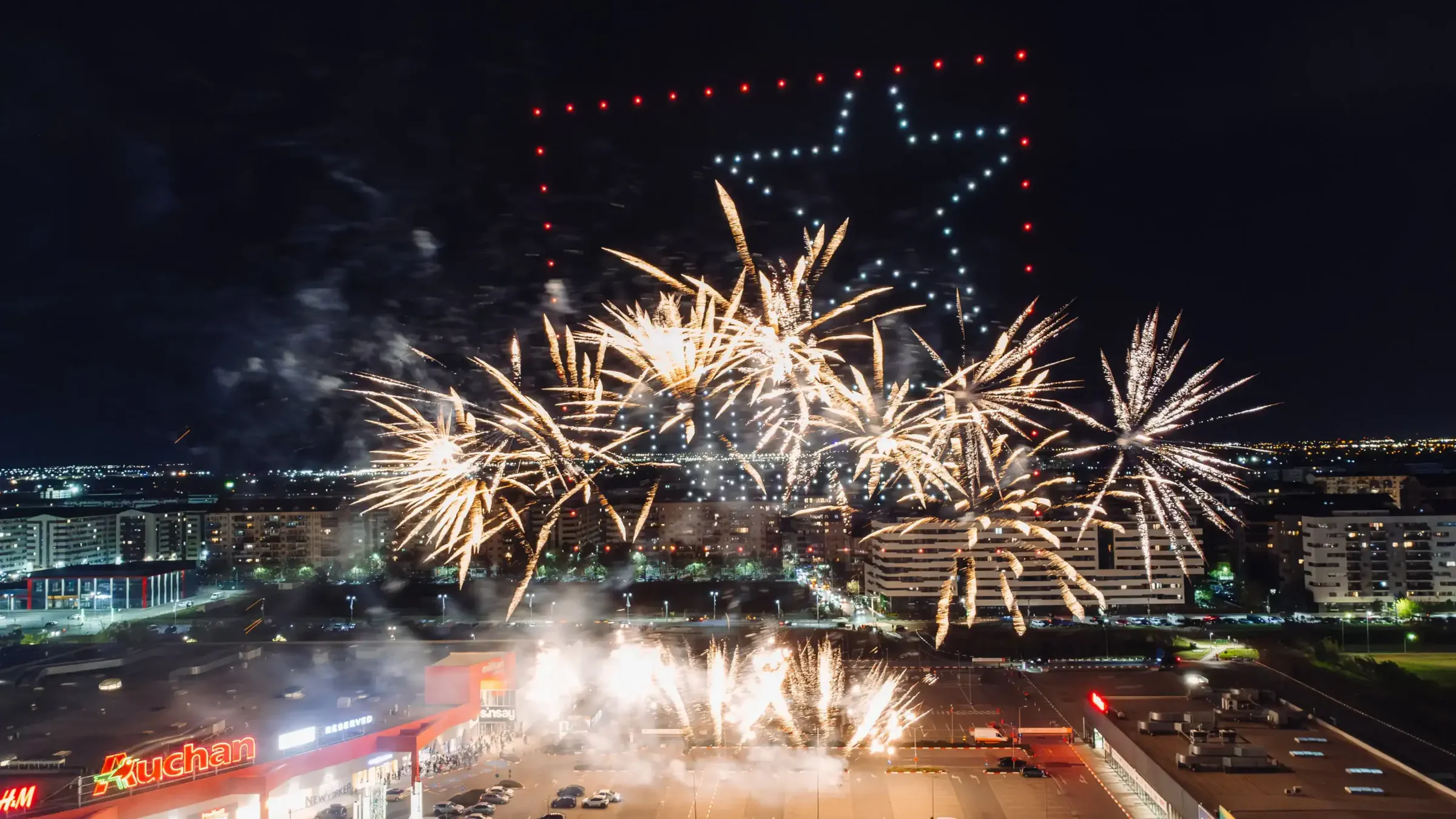
- A headline moment that needs both meaning and punch: a hybrid show, or drones and ground fireworks sharing one timeline.
- A recurring show or a season: drones become steadily more economical, because the aircraft are reused.
If you are weighing a hybrid show or building the capability as an operator, our services team can walk you through it.